
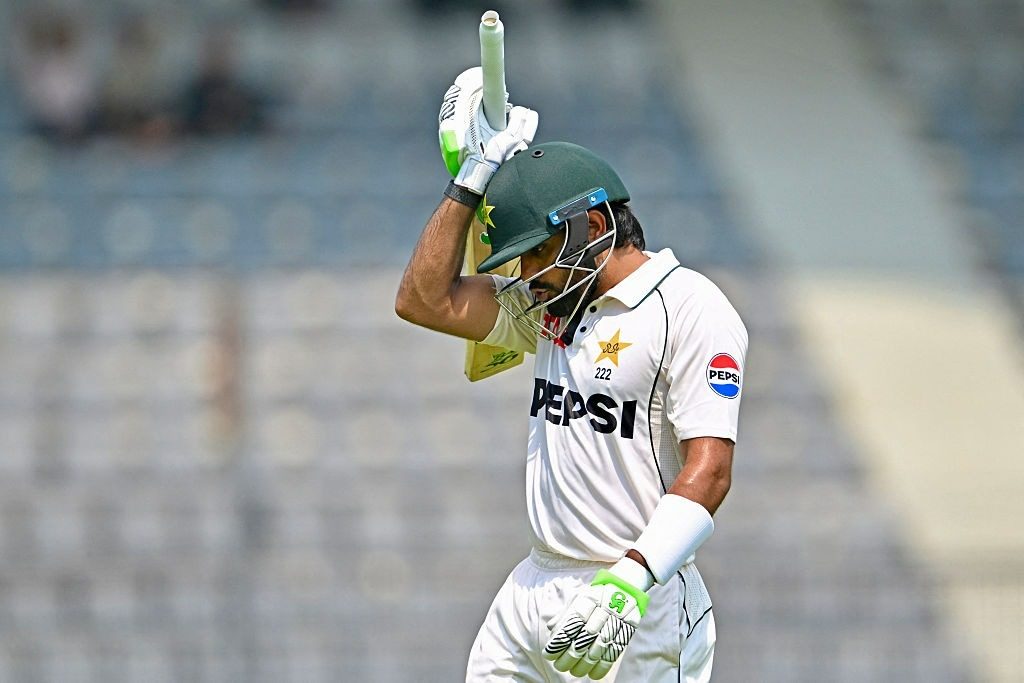
Pakistan's recent loss to the West Indies marked a challenging debut for Babar Azam as captain in his first Test since being reappointed ahead of the series. The decision to return to Azam as leader has faced scrutiny, with critics suggesting that the team should be looking for a long-term solution rather than reverting to a former captain. However, the latest defeat was less about leadership and more about a recurring theme that has plagued Pakistan's Test cricket since the South Africa series began in December 2024: the inability to maintain strong positions and finish innings effectively.
In the latest Test match, West Indies found themselves in a precarious position at 274-7 in their first innings but managed to recover to a total of 311, thanks to contributions from their lower order. Pakistan, after a rocky start at 1-1, appeared to be in control at 244-3, bolstered by a century from Shan Masood. Yet, they faltered dramatically, losing their final seven wickets for just 38 runs, resulting in a first-innings deficit. The trend continued as Pakistan reduced the West Indies to 93-7 in their second innings, only to see the hosts add another 88 runs, setting a target of 211 that Pakistan ultimately failed to chase down. This match exemplified the pattern of missed opportunities that has characterized Pakistan's recent performances.
Over the past eighteen months, Pakistan's defeats have followed a remarkably similar script, often marked by their failure to capitalize on advantageous situations. The team has consistently struggled to finish off innings, whether it be in their own batting or in containing the opposition. Instances such as South Africa’s last-wicket stand in Centurion, Bangladesh’s resurgence in Sylhet, and the West Indies’ late runs in various matches have all contributed to Pakistan’s downfall, leaving them in positions from which recovery has proven elusive.
Following the loss to the West Indies, head coach Sarfaraz Ahmed pointed to the rapid loss of wickets as a critical issue. He noted that Pakistan had a solid opportunity in the first innings, emphasizing that if opener Imam-ul-Haq had played a more patient innings, the team could have secured a better lead. Despite acknowledging the problem of collapses, Sarfaraz indicated that the issue extends beyond just the openers, highlighting the middle and lower order's inability to build on solid starts.
While individual performances have occasionally shone through, the lack of collective batting efforts has been glaring. Since the Boxing Day Test against South Africa in 2024, Pakistan has recorded three centuries and 26 fifties. However, only four of their 18 innings have featured more than two fifty-plus scores. The batting order has often crumbled after the fall of a single wicket, with only Babar Azam managing to remain unbeaten with a fifty during this stretch.
This lack of resilience has placed undue pressure on the lower order, which has struggled significantly. Since December 2024, Pakistan's Nos. 8-11 have scored a mere 467 runs at an average of 8.81, the lowest among Test-playing nations during this period. The tail has yet to register a half-century, and with 19 ducks, it’s evident that innings have frequently collapsed once recognized batters are dismissed.
Despite frequent changes in personnel, the underlying issues remain unchanged. Pakistan has fielded 26 players over the past year and a half, ranking third among Test-playing nations, yet they have only played nine Tests in that time. This indicates a team still searching for the right combination, but the problems run deeper than mere selection. The same patterns of play continue to dictate the outcomes of matches.
Babar Azam's return to captaincy was intended to provide stability to a side in search of consistency. However, the match in Tarouba highlighted that Pakistan's most significant challenge lies not in finding a new leader or combination but in learning to convert promising positions into victories. Until they address this issue, the narrow margins that have led to their defeats are unlikely to change.

Leave a Comment